%20rotate(-8.06)%22%2F%3E%0A%20%20%3Cpolygon%20class%3D%22cls-1%22%20points%3D%22336.19%20136.81%20330.16%2094.25%20326.06%2071.19%20326.44%2071.13%20335.22%2093.54%20352.29%20134.52%20373.95%20131.46%20362.7%2052.01%20350.02%2053.8%20356.05%2096.36%20360.15%20119.42%20359.77%20119.48%20350.99%2097.08%20333.91%2056.09%20312.25%2059.15%20323.51%20138.6%20336.19%20136.81%22%2F%3E%0A%20%20%3Cpolygon%20class%3D%22cls-1%22%20points%3D%22402.91%2059.3%20412.36%20126.02%20427.17%20123.92%20417.72%2057.21%20431.59%2055.24%20429.79%2042.51%20387.23%2048.53%20389.04%2061.27%20402.91%2059.3%22%2F%3E%0A%20%20%3Cpolygon%20class%3D%22cls-1%22%20points%3D%22463.51%20118.77%20458.69%2084.71%20474.68%2082.44%20479.51%20116.5%20494.36%20114.4%20483.11%2034.95%20468.26%2037.06%20472.96%2070.25%20456.96%2072.52%20452.26%2039.32%20437.4%2041.43%20448.65%20120.88%20463.51%20118.77%22%2F%3E%0A%20%20%3Cpolygon%20class%3D%22cls-1%22%20points%3D%22540.5%20107.87%20538.77%2095.68%20518.91%2098.49%20515.77%2076.29%20535.63%2073.47%20533.93%2061.5%20514.07%2064.32%20511.11%2043.42%20530.98%2040.61%20529.25%2028.42%20494.53%2033.34%20505.78%20112.78%20540.5%20107.87%22%2F%3E%0A%20%20%3Cpolygon%20class%3D%22cls-1%22%20points%3D%22299.03%20155.17%20301.29%20171.58%20542.78%20138.39%20540.5%20121.97%20299.03%20155.17%22%2F%3E%0A%3C%2Fsvg%3E)

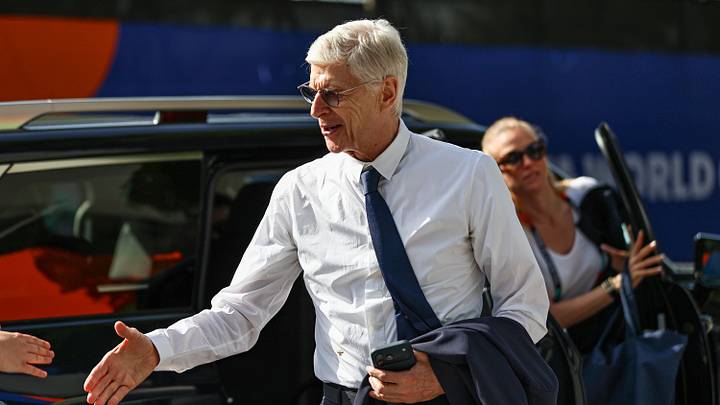
Arsenal's former professor Arsene Wenger could be set for a promotion to a new level within the game. Many are tipping the legendary manager to succeed Gianni Infantino as FIFA president, potentially bringing an end to the Swiss' tyrannical tenure.
Infantino has arguably plagued football over the last ten years, with his proximity to politics and his alignment with state power creating a sport increasingly devoid of the working-class soul that sprung it to life. He's worked mercilessly to add as many fixtures to the schedule as possible, purely for commercial self-interest, and has served as a propaganda machine for some of the dubious regimes he's liaised with during World Cups.
Wenger, so often lauded for being a man of principle and class, could change this. The Frenchman is currently enjoying his role as Chief of Global Football Development at FIFA, but could be the man to overthrow Infantino.
With that said, here are three football observations Wenger has made that make him the perfect candidate to save football from its increasingly maleficent ways.
Wenger is cognisant of the congested fixture schedule
No one can deny that there is too much football these days. While it means there is a constant revolving cast of teams fans can enjoy watching, there is no doubt that this fixture congestion is bad for the game and that the players need more protection to preserve the long-term quality of the product.
In 2021, Wenger argued that the international match calendar was outdated. He argued that the football calendar is inefficient and that players need more time to recover between games in order to improve the quality.
“I’ve been thinking of ways to improve the football of tomorrow,” he said.
“The international match calendar governs the balance between club and national team football by setting the dates on which players represent their countries. The balance is 80:20, and we want it to stay that way. But the current format doesn’t work anymore and is outdated.”
Wenger put forward plans to rearrange national team football into fewer but longer windows to reduce travel for players, allowing them to optimise their performance, whilst creating space for meaningful final tournaments without adding more matches in total. He also advocated for establishing an annual mandatory rest period for players.
He's managed to push through some of these plans, with the first three-week international break taking place this autumn. However, there's still a long way to go on this front.
Fewer games and more rest is generally a policy that fans, players, and coaches are in support of, yet those in power at FIFA are rallying against this as they look to maximise revenues. Wenger gets it, which makes him a great candidate for FIFA presidency. He wants to act in the best interests of the game in the long-term.
Wenger is intent on developing the game globally
Alongside protecting players physically, Wenger is a strong advocate for the global advancement of the game. This makes sense given it's the primary objective of his current role, but making sure football develops in every part of the world isn't always at the forefront of the minds of those at the highest level of FIFA, with wealthy nations often favoured for investment as they can produce the highest revenues in the short term.
Speaking about his role at FIFA in 2019, Wenger highlighted the gap between Europe and the rest of the world, arguing that the governing body has a responsibility to ensure that the sport develops at the same rate everywhere.
"FIFA has three roles: one as an organiser of competitions, the second as a regulator of competitions and rules, and the third is developing football all over the world," he said.
"In Europe, we are privileged that on the organisational front, there is not too much to do. But there is a huge gap between Europe and the rest of the world.
"FIFA has a responsibility to ensure football is developing at the same rate everywhere. There is a demand there for the organisation of competitions, coaching development, player development – and that’s what we’re trying to do."
Understanding that FIFA is responsible for the game developing worldwide is crucial, particularly given the aforementioned lack of recognition of this obligation from other members of football's governing body. If Wenger can improve the quality of coaching, academies and opportunies across the globe, that will only prove to be a good thing for the sport.
Wenger's philosophical outlook on creativity aligns with a more entertaining product
Away from more administrative matters, Wenger's identity as a football thinker makes him the perfect candidate to take the reins.
Speaking about player development in 2025, Wenger warned that football had become too structured, with players becoming too focused on following instuctions rather than expressing themselves creatively.
“I would say that in the last 20 years, the freedom of the players has been reduced. The importance of the structure has been emphasised a lot,” he said.
“I think sometimes that the players play more to respond to what they have been told do (rather) than to express themselves and their freedom. And too many norms kill creativity. That’s why, certainly, coaching, to educate the coaches again, is very important because we all love the game to see things we don’t expect to see. We all love the game because we like the element of surprise. When a player does something that you don’t expect.
"We have to create unpredictability again and players who have their own personality. To develop their personality at a young age and develop their creativity. This is an important element that we have to take care of.”
More freedom of expression will result in more entertaining football, and that's what we all ultimately want.
 Add us as a preferred source on Google