%20rotate(-8.06)%22%2F%3E%0A%20%20%3Cpolygon%20class%3D%22cls-1%22%20points%3D%22336.19%20136.81%20330.16%2094.25%20326.06%2071.19%20326.44%2071.13%20335.22%2093.54%20352.29%20134.52%20373.95%20131.46%20362.7%2052.01%20350.02%2053.8%20356.05%2096.36%20360.15%20119.42%20359.77%20119.48%20350.99%2097.08%20333.91%2056.09%20312.25%2059.15%20323.51%20138.6%20336.19%20136.81%22%2F%3E%0A%20%20%3Cpolygon%20class%3D%22cls-1%22%20points%3D%22402.91%2059.3%20412.36%20126.02%20427.17%20123.92%20417.72%2057.21%20431.59%2055.24%20429.79%2042.51%20387.23%2048.53%20389.04%2061.27%20402.91%2059.3%22%2F%3E%0A%20%20%3Cpolygon%20class%3D%22cls-1%22%20points%3D%22463.51%20118.77%20458.69%2084.71%20474.68%2082.44%20479.51%20116.5%20494.36%20114.4%20483.11%2034.95%20468.26%2037.06%20472.96%2070.25%20456.96%2072.52%20452.26%2039.32%20437.4%2041.43%20448.65%20120.88%20463.51%20118.77%22%2F%3E%0A%20%20%3Cpolygon%20class%3D%22cls-1%22%20points%3D%22540.5%20107.87%20538.77%2095.68%20518.91%2098.49%20515.77%2076.29%20535.63%2073.47%20533.93%2061.5%20514.07%2064.32%20511.11%2043.42%20530.98%2040.61%20529.25%2028.42%20494.53%2033.34%20505.78%20112.78%20540.5%20107.87%22%2F%3E%0A%20%20%3Cpolygon%20class%3D%22cls-1%22%20points%3D%22299.03%20155.17%20301.29%20171.58%20542.78%20138.39%20540.5%20121.97%20299.03%20155.17%22%2F%3E%0A%3C%2Fsvg%3E)

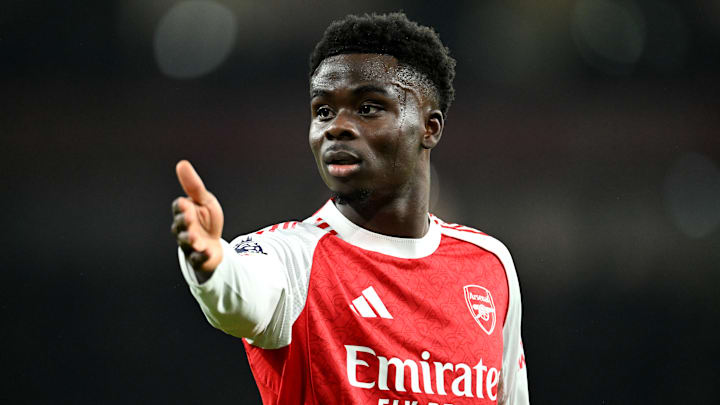
Identifying Arsenal's standout players from a hugely disappointing 3-2 home defeat to Manchester United is close to mission impossible, but there were some silver linings from an otherwise hugely frustrating day. A day when the focus of people's ire should be a manager with a reputation inflated by know-all fans, media sycophants and a spending budget 10 other gaffers can only dream about.
Mikel Arteta's negative tactics and overly-structured team design are why this Arsenal side serially fails to seize the initiative in the Premier League title race. Those tactics still boil down to only two things: play for set-pieces and if that fails, get the ball to Bukayo Saka and hope for the best.
Fortunately, Saka is still delivering, creating both goals, but his one-man show was undone by the lack of ideas around him. A lack of ideas summed by two defenders being the only other attacking threats of note for the overly cautious, unimaginative Gunners.
When centre-back William Saliba and right-back Jurrien Timber are legitimate attacking outlets, your team has been paired down to high-school level in the final third. Yet at least Timber and Saliba tried to carry the fight to United.
Their industry alone is enough to qualify them as standout performers among a team that once again wilted under the spotlight.
Standout players from Arsenal's dismal 2-3 defeat vs. Manchester United
1. Bukayo Saka

Saka or bust is shorthand for the Arteta attacking plan. The fact it's worked so often in recent years owes more to the England winger's talents than any grand design by the manager.
Those talents include preternatural balance, natural acceleration and deceptive body strength. Not to mention an increasing willingness by Saka to chance his right foot from either side of the pitch.
All of those things had United reeling for most of the first half. Some typical Saka stop-start magic helped manufacture the opening goal, when the 24-year-old prodded the ball into a dangerous area and Timber made enough of a nuisance of himself for Lisandro Martinez to bundle the ball over the line.
Frankly, that was as good as things got for Saka, even though he remained lively throughout. The problem was United wised up to the threat and began doubling and even tripling up on the gifted No. 7.
Saka still delivered the corner Mikel Merino turned in for what would've been an undeserved equaliser. A low drive from Saka also stung the palm of United goalkeeper Senne Lammens, but there were precious few other dynamic slaloms from Arsenal's wing wizard.
Perhaps Saka would've enjoyed greater room and more of the ball if Arteta permitted a second striker or additional creative player in central areas. As it is, Saka's best company going forward was provided by defenders.
2. Jurrien Timber

Giving credit to defenders after a game when Arsenal conceded three goals may not compute for some. Yet there's a two-fold implication to Timber and Saliba appearing on this list.
They're included because nobody else, bar Saka, offered any inspiraton going forward. There was no inspiration going forward because Arteta emphasises structure over style, the exact tactical template defenders love.
Timber is a beneficiary of a manager who treats an inverted full-back with more reverence than a true No. 10 or a natural goal-getter. The inverted full-back ploy does have some merit, like when Timber's frequent raids into the striker spot caused United problems early. His pressure eventually told when Timber gave Martinez too much to think about in the 29th minute.
The problem is a full-back raiding forward should be gravy, icing on the cake, whatever you want to call a handy extra. A bonus to supplement forward players, not the central pillar of Arsenal's attacking plan.
3. William Saliba

Saliba progressing the ball almost the length of the pitch became a common sight as the match wore on toward its bitter conclusion. A too common sight.
A central defender shouldn't be the catalyst for Arsenal's most purposeful raids forward, When that happens, it's the result of an attacking strategy narrow in its focus and devoid of the flair and ingenuity to create chances and score freely from open play.
This tired and depressingly familiar approach makes it more likely Saliba's commendable runs at United's back line were the player seizing the initiative. Not any enterprising tactical tweak from those on the touchline.
Saliba is used to doing the unexpected. Whether it's proving a legend of the French game wrong or showcasing impressive aptitude and ambition on the ball.
All that's missing is a league title to quantify Saliba's positive impact on Arsenal. Unfortunately, one of those will still prove elusive if Arteta can't find better ways to coach his team how to play on the front foot.
 Add us as a preferred source on Google