%20rotate(-8.06)%22%2F%3E%0A%20%20%3Cpolygon%20class%3D%22cls-1%22%20points%3D%22336.19%20136.81%20330.16%2094.25%20326.06%2071.19%20326.44%2071.13%20335.22%2093.54%20352.29%20134.52%20373.95%20131.46%20362.7%2052.01%20350.02%2053.8%20356.05%2096.36%20360.15%20119.42%20359.77%20119.48%20350.99%2097.08%20333.91%2056.09%20312.25%2059.15%20323.51%20138.6%20336.19%20136.81%22%2F%3E%0A%20%20%3Cpolygon%20class%3D%22cls-1%22%20points%3D%22402.91%2059.3%20412.36%20126.02%20427.17%20123.92%20417.72%2057.21%20431.59%2055.24%20429.79%2042.51%20387.23%2048.53%20389.04%2061.27%20402.91%2059.3%22%2F%3E%0A%20%20%3Cpolygon%20class%3D%22cls-1%22%20points%3D%22463.51%20118.77%20458.69%2084.71%20474.68%2082.44%20479.51%20116.5%20494.36%20114.4%20483.11%2034.95%20468.26%2037.06%20472.96%2070.25%20456.96%2072.52%20452.26%2039.32%20437.4%2041.43%20448.65%20120.88%20463.51%20118.77%22%2F%3E%0A%20%20%3Cpolygon%20class%3D%22cls-1%22%20points%3D%22540.5%20107.87%20538.77%2095.68%20518.91%2098.49%20515.77%2076.29%20535.63%2073.47%20533.93%2061.5%20514.07%2064.32%20511.11%2043.42%20530.98%2040.61%20529.25%2028.42%20494.53%2033.34%20505.78%20112.78%20540.5%20107.87%22%2F%3E%0A%20%20%3Cpolygon%20class%3D%22cls-1%22%20points%3D%22299.03%20155.17%20301.29%20171.58%20542.78%20138.39%20540.5%20121.97%20299.03%20155.17%22%2F%3E%0A%3C%2Fsvg%3E)

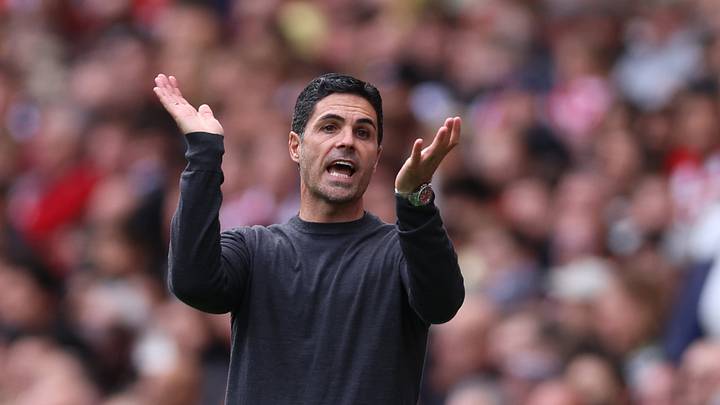
Arsenal took their first shot against Leeds United on Saturday afternoon in the 21st minute, when Noni Madueke's cross was headed straight at James Trafford by Kai Havertz.
Mikel Arteta's team finished the opening 45 minutes having yielded just four shots, despite having 60% of the ball. Only one of these shots came from outside the box, despite having plenty of possession in and around Leeds' penalty area.
The Gunners finished the game having taken 13 shots for 2.33 expected goals (via FotMob). This equates to 0.18 xG per shot - the Premier League team average is 0.11 (via StatMuse).
Arsenal have the second-highest xG per shot in the English top flight so far this season, with 0.14. Only Crystal Palace take higher-quality shots at 0.15. Meanwhile, the North Londoners are eleventh in the table for total shots (via FBRef) and have the seventh-shortest average shot distance from goal (via Opta Analyst).
It's safe to assume that this is by design. The Arsenal players are instructed to work the best possible shooting opportunity rather than let fly from distance. It makes sense on paper, but is it actually costing them?
Arsenal's moneyball approach might be hurting their attack
The Moneyball approach stems from Michael Lewis' 2003 book about the Oakland Athletics, a baseball team that massively overperformed based on the resources available to them by adopting a revolutionary sabermetric approach to recruitment. They found hidden gems on the market by using advanced data analytics that other clubs weren't using.
This emphasis on complex statistics made its way into other sports, including football, and has led to massive changes in the way the game is played in recent years. Although it sounds obvious, data analytics made it clear that taking long-range shots wastes attacking opportunities, and teams should instead look to create goal-scoring chances of higher value inside the opposition's box.
It might sound obvious, but if you watch games from even ten years ago, it didn't seem like it was obvious to most teams. Highlights from 2015/16 almost always show players attempting ridiculously difficult efforts from insane distances and angles. Teams still get their best long-range shooters to take shots from range, but normally from the edge of the box rather than 60 yards out when running away from goal.
Arteta, who is typically open to adopting approaches supported by data, has clearly taken this advice from his analytics team and instructed his players not to 'shoot on sight', but rather to work as hard as possible for the perfect chance. More than ever, the Gunners are standing out in all the metrics that show this, as highlighted in the intro to this piece.
While this approach is generally sensible, Arsenal might be leaning into it too much. They have a handful of specialist long-range shooters, such as Bruno Guimaraes, Eberechi Eze and arguably Martin Odegaard, who they should be giving license to hit the ball when close to the box and in space.
Guimaraes has already produced two match-winning goals from range this season, Odegaard has produced one in the Champions League, and Eze delivered several last season. Should Myles Lewis-Skelly or Ben White be given the freedom to let fly from ten yards outside the box? No. But the specialists should be.
There is no need to rip up the playbook and ignore all the statistical evidence by allowing everyone to shoot from anywhere - like Manchester United have done to little avail this season (they rank bottom this season for almost all the metrics discussed earlier). However, Arteta doesn't need to be so stringent about this policy, particularly in games when Arsenal are struggling to work the good opportunities.
Against Leeds in the first half, there were numerous opportunities for the likes of Odegaard and Declan Rice to shoot when they had a lot of space not too far outside the box. Instead, they moved it on, and the play led nowhere. These are extremely technical players who have the ability to, at the very least, hit the target, which can lead to ricochets, rebounds and chaos.
Ultimately, Arsenal's coaching staff are doing very little wrong. They've created a winning machine in a league with more parity than ever before. However, a slight tweak to their moneyball approach could work wonders.
 Add us as a preferred source on Google