%20rotate(-8.06)%22%2F%3E%0A%20%20%3Cpolygon%20class%3D%22cls-1%22%20points%3D%22336.19%20136.81%20330.16%2094.25%20326.06%2071.19%20326.44%2071.13%20335.22%2093.54%20352.29%20134.52%20373.95%20131.46%20362.7%2052.01%20350.02%2053.8%20356.05%2096.36%20360.15%20119.42%20359.77%20119.48%20350.99%2097.08%20333.91%2056.09%20312.25%2059.15%20323.51%20138.6%20336.19%20136.81%22%2F%3E%0A%20%20%3Cpolygon%20class%3D%22cls-1%22%20points%3D%22402.91%2059.3%20412.36%20126.02%20427.17%20123.92%20417.72%2057.21%20431.59%2055.24%20429.79%2042.51%20387.23%2048.53%20389.04%2061.27%20402.91%2059.3%22%2F%3E%0A%20%20%3Cpolygon%20class%3D%22cls-1%22%20points%3D%22463.51%20118.77%20458.69%2084.71%20474.68%2082.44%20479.51%20116.5%20494.36%20114.4%20483.11%2034.95%20468.26%2037.06%20472.96%2070.25%20456.96%2072.52%20452.26%2039.32%20437.4%2041.43%20448.65%20120.88%20463.51%20118.77%22%2F%3E%0A%20%20%3Cpolygon%20class%3D%22cls-1%22%20points%3D%22540.5%20107.87%20538.77%2095.68%20518.91%2098.49%20515.77%2076.29%20535.63%2073.47%20533.93%2061.5%20514.07%2064.32%20511.11%2043.42%20530.98%2040.61%20529.25%2028.42%20494.53%2033.34%20505.78%20112.78%20540.5%20107.87%22%2F%3E%0A%20%20%3Cpolygon%20class%3D%22cls-1%22%20points%3D%22299.03%20155.17%20301.29%20171.58%20542.78%20138.39%20540.5%20121.97%20299.03%20155.17%22%2F%3E%0A%3C%2Fsvg%3E)

WARNING: this article contains details which some readers may find distressing, enraging or else just downright hilarious.
Cases of ADS – or Arsenal Derangement Syndrome – are said to have spiked across England in recent weeks.
Experts had thought that the warm weather of summer 2026 would reduce transmission rates, when the football world had time to accept Arsenal as a top-class team following their Premier League title win and a UCL final appearance.
Find out what Arsenal Derangement Syndrome is, recognise its symptoms, and learn what you can do to avoid it
But the return of club football for 2026/27 has seen ADS levels rise to near its pre-title highs, with the Gunners starting their title defence in style (perhaps we should all pretend the 3-0 defeat at Brighton never happened).
Please read on to learn what ADS is, recognise its most common symptoms and to find out what you can do to avoid it.
What is ADS?
ADS refers to Arsenal Derangement Syndrome, a brutal disease which causes PL supporters to lose all sense of rhyme or reason when asked (or not asked) to pass judgement on refereeing decisions that go in the Gunners’ favour.
Symptoms
- Distorted vision: ADS sufferers often view incidents in a way that conflicts with reality and, thus, they can cause themselves great irritation.
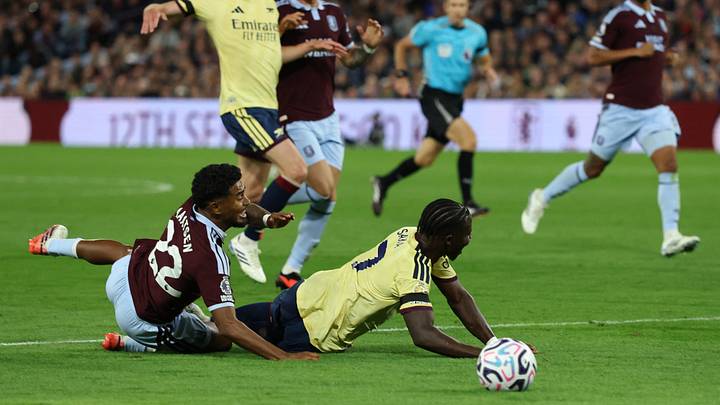
GW2 brought about a dire case of this ailment, when Ian Maatsen fell theatrically after slight contact from Ben White in the penalty box and ADS carriers foamed at the mouth because Aston Villa were denied a spot kick.
If you spot the signs, do not react. Feeding into their delusion only makes things worse for victim and Arsenal fans alike.
- Irrational judgement: This is the most dangerous trait of ADS. Sufferers are known to be irrational or demand extreme punishment for on-field incidents which generally fail to meet one, small criterion: what the rulebook actually says.
Reports of irrational judgement have multiplied in the opening weeks and it has involved Declan Rice. Rival fans screamed for him to be sent off against Chelsea and Brighton for his petulant kick outs on Morgan Rogers and Malick Yalcouye, despite the fact that professional fouls and petulance are only punishable by a yellow card.
Imagine if the referee spotted the trip on Rogers! The Blues might have had another shot from 30+ yards out to add to the other eight that flew off target, instead of merely getting an advantage that they then proceeded to waste anyway.
- Nervous ramblings/turning a blind eye: These last two symptoms go hand in hand. ADS folk can be heard rambling “same old Arsenal, always cheating” even when the Arsenal player has been hacked brutally to the ground, whilst they simultaneously ignore any bad referee decision that goes in favour of their own team.
Again, Villa Park was rampant with ADS in GW2 as “always cheating” rang out when Bukayo Saka was hauled down by Maatsen and VAR stepped in to overturn the penalty call. Home fans did not realise that the check was conducted not due to suspicions of diving, but because there was doubt whether or not the DEFINITE foul had happened in the box.
And the worst effects of ADS had not worn off by the end, when Bruno Guimaraes was brought down by Maatsen (again) in the penalty box. It was the only incident from the match that the PL KMI panel would deem a clear and obvious error. Funny that.
Special mention must also go to Chelsea fans who bayed for a Gabriel red card after his kick on Emi Martinez, something for which the KMI panel also sided with Arsenal. That Rice ‘assault’ on Rogers, on the other hand, was not even worthy of their investigation.
How to avoid ADS
Cases of ADS have risen along the south coast and the West Midlands in recent days, while the away end at Emirates Stadium has also seen a spike. Arsenal fans are advised to stay far away from these areas on matchdays.
In addition, those with their mental faculties intact are asked not to go on social media, especially in the hours after an Arsenal win. ADS is highly contagious online and there is no amount of face masks that can save you there.
Roadmap for ADS in 2026/27
ADS is expected to go from strength to strength over the next eight months but Arsenal supporters are urged to stand strong, block out the noise and just enjoy the success of their own team. Once it gets starved of attention, ADS loses its virulence and a maiden UCL triumph might just knock it out of existence altogether.
Don’t hold your breath.
 Add us as a preferred source on Google