%20rotate(-8.06)%22%2F%3E%0A%20%20%3Cpolygon%20class%3D%22cls-1%22%20points%3D%22336.19%20136.81%20330.16%2094.25%20326.06%2071.19%20326.44%2071.13%20335.22%2093.54%20352.29%20134.52%20373.95%20131.46%20362.7%2052.01%20350.02%2053.8%20356.05%2096.36%20360.15%20119.42%20359.77%20119.48%20350.99%2097.08%20333.91%2056.09%20312.25%2059.15%20323.51%20138.6%20336.19%20136.81%22%2F%3E%0A%20%20%3Cpolygon%20class%3D%22cls-1%22%20points%3D%22402.91%2059.3%20412.36%20126.02%20427.17%20123.92%20417.72%2057.21%20431.59%2055.24%20429.79%2042.51%20387.23%2048.53%20389.04%2061.27%20402.91%2059.3%22%2F%3E%0A%20%20%3Cpolygon%20class%3D%22cls-1%22%20points%3D%22463.51%20118.77%20458.69%2084.71%20474.68%2082.44%20479.51%20116.5%20494.36%20114.4%20483.11%2034.95%20468.26%2037.06%20472.96%2070.25%20456.96%2072.52%20452.26%2039.32%20437.4%2041.43%20448.65%20120.88%20463.51%20118.77%22%2F%3E%0A%20%20%3Cpolygon%20class%3D%22cls-1%22%20points%3D%22540.5%20107.87%20538.77%2095.68%20518.91%2098.49%20515.77%2076.29%20535.63%2073.47%20533.93%2061.5%20514.07%2064.32%20511.11%2043.42%20530.98%2040.61%20529.25%2028.42%20494.53%2033.34%20505.78%20112.78%20540.5%20107.87%22%2F%3E%0A%20%20%3Cpolygon%20class%3D%22cls-1%22%20points%3D%22299.03%20155.17%20301.29%20171.58%20542.78%20138.39%20540.5%20121.97%20299.03%20155.17%22%2F%3E%0A%3C%2Fsvg%3E)

All the talks about Arsenal this season has been around their style of play. Bitter rivals fans and prominent media figures are labelling the Gunners boring, with some asserting that they'd be the worst champions ever. Well, given that Mikel Arteta's team have won 35 of 46 matches across all competitions this season, losing only three and scoring 101 goals in the process, these figures should probably focus on their own club's shortcomings first and foremost.
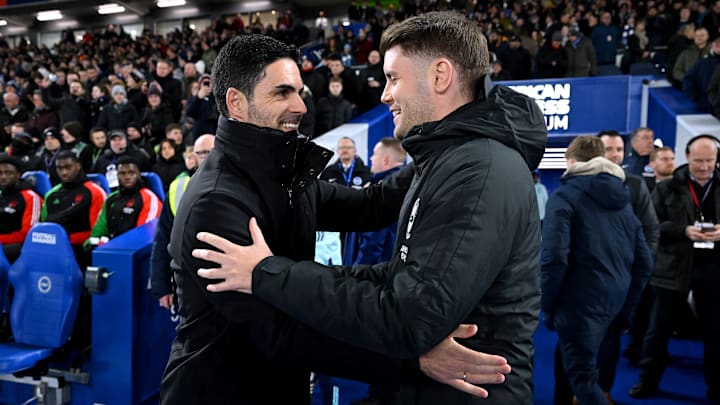
Fire was though added to the flames when Brighton & Hove Albion manager Fabian Hürzeler made his feelings clear. Arsenal were 1-0 winners at the Amex last Wednesday, their third victory out of three over the Seagulls this season, and the 33-year-old had this to say after the match:
"Only one team tried to play football... they are doing their own rules. I will never be that kind of manager who tries to win in that way. "
When these comments were put to Arteta soon after, all he had to say was "what a surprise", suggesting the pair won't be seated next to one another come the League Managers Association award ceremony. So, are Hürzeler's claims based in reality?
Well, the German was most upset about time wasting, annoyed that David Raya halted the match on multiple occasions to receive treatment. According to Opta's the Analyst, the Gunners spent an average of 31.4 seconds to get the ball back into play from restarts. This seems like a lot, until you find the context that there have been 195 instances of a team taking longer than this across the 291 Premier League matches that have been played to date this season.
To expand on this further, Opta go on to note that Arsenal's total delay from restarts was 1,851 seconds, over half an hour, which also seems like a huge amount of time. Once again though, 21 teams have wasted more time in a Premier League fixture this season already, showing that Arteta's team were up to nothing out of the ordinary. So, let's comparing this to every other team in the division:
Average delay time before restarting play: Premier League 25/26
Clubs | Average time delay in seconds |
|---|---|
Liverpool | 25.8 |
Brighton | 26.5 |
Manchester City | 26.6 |
Fulham | 26.7 |
Bournemouth | 27.6 |
Nottingham Forest | 27.7 |
Manchester United | 28 |
Wolves | 28.9 |
Everton | 29.4 |
West Ham United | 29.6 |
Chelsea | 29.6 |
Tottenham Hotspur | 29.8 |
Aston Villa | 29.8 |
Burnley | 30 |
Arsenal | 30.2 |
Leeds United | 30.4 |
Newcastle United | 30.8 |
Crystal Palace | 31.2 |
Brentford | 32.3 |
Sunderland | 33.1 |
Note: All statistics courtesy of Opta's the Analyst.
According to Opta's research, in fairness to Hürzeler, only Liverpool get play restarted quicker than his team, but there's very little in across the board. Arsenal do take around 30 seconds on average to get the ball back in play, only five clubs take a longer period of time.
The majority of this comes from corners, with the Gunners taking the most time on average to deliver a corner, 44.5 seconds, albeit they only had three at the Amex, so that would not have made much tangible difference on the difference. So why is this? Well, from corners specifically, Nicolas Jover seemingly believes that a delay before delivery will increase the fear in opponents, building the tension among the crowd either home or away, and could lead to defenders losing concentration.
More broadly, Arsenal have been in the lead 45% of the time in the Premier League this season, second only to Manchester City, while trailing just 9% of the time, so it is natural that they'll want to slow the game down.
Thus, the hypothesis that Arteta's team are playing by their own rules is not based in reality, and it's time that the quadruple-chasing Premier League leaders were actually given some respect, rather than being widely criticised and dismissed by jealous onlookers.
 Add us as a preferred source on Google