%20rotate(-8.06)%22%2F%3E%0A%20%20%3Cpolygon%20class%3D%22cls-1%22%20points%3D%22336.19%20136.81%20330.16%2094.25%20326.06%2071.19%20326.44%2071.13%20335.22%2093.54%20352.29%20134.52%20373.95%20131.46%20362.7%2052.01%20350.02%2053.8%20356.05%2096.36%20360.15%20119.42%20359.77%20119.48%20350.99%2097.08%20333.91%2056.09%20312.25%2059.15%20323.51%20138.6%20336.19%20136.81%22%2F%3E%0A%20%20%3Cpolygon%20class%3D%22cls-1%22%20points%3D%22402.91%2059.3%20412.36%20126.02%20427.17%20123.92%20417.72%2057.21%20431.59%2055.24%20429.79%2042.51%20387.23%2048.53%20389.04%2061.27%20402.91%2059.3%22%2F%3E%0A%20%20%3Cpolygon%20class%3D%22cls-1%22%20points%3D%22463.51%20118.77%20458.69%2084.71%20474.68%2082.44%20479.51%20116.5%20494.36%20114.4%20483.11%2034.95%20468.26%2037.06%20472.96%2070.25%20456.96%2072.52%20452.26%2039.32%20437.4%2041.43%20448.65%20120.88%20463.51%20118.77%22%2F%3E%0A%20%20%3Cpolygon%20class%3D%22cls-1%22%20points%3D%22540.5%20107.87%20538.77%2095.68%20518.91%2098.49%20515.77%2076.29%20535.63%2073.47%20533.93%2061.5%20514.07%2064.32%20511.11%2043.42%20530.98%2040.61%20529.25%2028.42%20494.53%2033.34%20505.78%20112.78%20540.5%20107.87%22%2F%3E%0A%20%20%3Cpolygon%20class%3D%22cls-1%22%20points%3D%22299.03%20155.17%20301.29%20171.58%20542.78%20138.39%20540.5%20121.97%20299.03%20155.17%22%2F%3E%0A%3C%2Fsvg%3E)

Hype and Mikel Arteta's "project" are never too far apart for long, but things were getting out of control for Arsenal this early in the 2026/27 season.
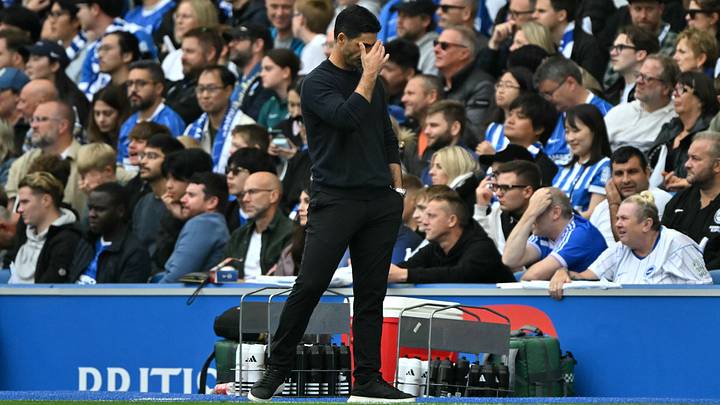
At least they were until the Gunners travelled to Amex Stadium on Saturday, September 19 and were promptly turned over by Brighton & Hove Albion, losing 3-0. A scoreline that still somehow flattered the over-inflated reigning Premier League champions.
Arteta usually gets credit for every good thing that happens to Arsenal, while rarely incurring any criticism for the negatives, but not even the "Process King" could've planned a more emphatic wake-up call, after Brighton outran, outmuscled and thoroughly outplayed his players.
A short, sharp shock of reality was called for after the hype machine went into overdrive after every previous result. In the process, the overdose of toxic positivity blinded observers from the potentially fatal flaws in Arteta's team, and who deservers some of the blame for them.
Arsenal's performances were overhyped before Brighton
The glow of Arsenal delivering a first domestic title in over two decades turned support and admiration into frenzy for this season's early performances. Just think back to reactions to the first two results of this English top-flight campaign, a 3-0 home win over Coventry City, followed by a 1-0 victory away to Aston Villa.
Clean sheets are always welcome, but these two were heralded as some sort of proof Arsenal possessed a defence for the ages. An apex Catenaccio taken to its perfect zenith.
It didn't matter to anybody one of those clean sheets came at the expense of a newly-promoted club playing away from home in its first Premier League game in almost a quarter of a century.
Nobody cared that the Gunners next blanked a Villa side stripmined during the summer transfer window. A squad robbed of the attacking and creative talents of Ollie Watkins, Morgan Rogers and Youri Tielemans, three players decisive when Villa beat Arsenal 2-1 in the corresponding fixture last season.
The overreaction meter swung to the other end of the pitch when Arsenal beat Chelsea 2-1 at the Emirates Stadium. Arteta's men played some free-flowing stuff, but you'd be forgiven for thinking the Gunners had redefined what us mere mortals thought of as attacking football.
Poetry in motion 🤩@Arsenal 🤌 pic.twitter.com/XfGkv1dfX7
— Premier League (@premierleague) September 9, 2026
No matter Xabi Alonso's Chelsea might be the most open team this season. Or in any other season. A top-heavy, fragile entity seemingly on a quest to turn conceding the most goals into an award-worthy achievement.
Any nuance about Arsenal's performances was unnecessary because context was no longer King. The victim of a coup d'état in favour of relentless enthusiasm to treat every positive as indisputable further proof of Arteta's masterplan.
It's worth re-examining that plan after the mess against the Seagulls. If only to acknowledge the two glaring holes in the strategy.
Arteta has a role in Arsenal's major flaws
Identifying the two major flaws in this Arsenal squad isn't difficult. It helps both flaws add up to the same thing. Namely, a dangerous imbalance for a defence-first team.
The Gunners had become too tethered to the hype about their defensive invulnerability. Hype shattered by shipping three goals against Brighton.
Clean sheets are invaluable currency that earn Arsenal the platform to win any game, but believing you can keep them automatically is dangerous thinking. Saying you expect to stop the opposition from scoring in every match is no different than proclaiming it doesn't matter if you concede three goals because you can score four each game.
The difference is heroic defending's often treated as a more worthy, more masculine approach to succeeding in football. Words like discipline, steel, organisation, aggression commitment, focus, chracter and spine are attributed to teams solid defensively. Whereas more cavalier teams daring enough to commit extra bodies to forward enterprises are flimsy, flaky and finesse.
Ultimately, it doesn't matter which side of the game you prefer. Any imbalance is dangerous.
Arteta may learn that the hard way because this season's team is not different enough to the title-winning vintage. In other words, the Gunners of this campaign are still short in attack. Shorter, actually, because Leandro Trossard, Gabriel Martinelli and Gabriel Jesus were sold and not adequately replaced.
That's on Arteta and the Arsenal recruitment machine not being in lockstep. Arteta can't cry poverty because he's NEVER been denied cash in this job.
There's little point bemoaning failed attempts to sign Julián Alvarez or Vinícius Júnior. Not when Arteta green-lit spending nearly £90 million on two central defenders, Piero Hincapié and Ezri Konsa. Nor when Arsenal dropped £34 million to sign Christos Tzolis, a winger last seen on these shores with Norwich City.
Or how about parting with £75 million to sign a 29-year-old defensive midfielder, Bruno Guimarães? It's hard to make a game-changing signing up front if you don't, you know, commit to signing a game-changer.
Arteta can try and redefine what makes a great striker all he wants, but he's not going to convince anybody Kai Havertz merits that label. Nor is the manager exempt from culpability for his team's "most adventurous" player being a left-back, per Sam Dean of The Daily Telegraph.
There's an argument to be made that Riccardo Calafiori is Arsenal's most adventurous player, despite being a defender. He's the one player who makes consistently unpredictable movements off the ball.
— Sam Dean (@SamJDean) August 31, 2026
Arteta's always been more George Graham than Arsene Wenger, and he just about got away with it last season, but things are diffefent this campaign. Manchester City are more dynamic and artful in the final third, so an already overly defensive Arsenal squad missing vital ingredients in attack can't take keeping pace for granted.
Especially if the Gunners are going to collapse at the back and surrender the initiative higher up the pitch the way they did against Brighton.
 Add us as a preferred source on Google