%20rotate(-8.06)%22%2F%3E%0A%20%20%3Cpolygon%20class%3D%22cls-1%22%20points%3D%22336.19%20136.81%20330.16%2094.25%20326.06%2071.19%20326.44%2071.13%20335.22%2093.54%20352.29%20134.52%20373.95%20131.46%20362.7%2052.01%20350.02%2053.8%20356.05%2096.36%20360.15%20119.42%20359.77%20119.48%20350.99%2097.08%20333.91%2056.09%20312.25%2059.15%20323.51%20138.6%20336.19%20136.81%22%2F%3E%0A%20%20%3Cpolygon%20class%3D%22cls-1%22%20points%3D%22402.91%2059.3%20412.36%20126.02%20427.17%20123.92%20417.72%2057.21%20431.59%2055.24%20429.79%2042.51%20387.23%2048.53%20389.04%2061.27%20402.91%2059.3%22%2F%3E%0A%20%20%3Cpolygon%20class%3D%22cls-1%22%20points%3D%22463.51%20118.77%20458.69%2084.71%20474.68%2082.44%20479.51%20116.5%20494.36%20114.4%20483.11%2034.95%20468.26%2037.06%20472.96%2070.25%20456.96%2072.52%20452.26%2039.32%20437.4%2041.43%20448.65%20120.88%20463.51%20118.77%22%2F%3E%0A%20%20%3Cpolygon%20class%3D%22cls-1%22%20points%3D%22540.5%20107.87%20538.77%2095.68%20518.91%2098.49%20515.77%2076.29%20535.63%2073.47%20533.93%2061.5%20514.07%2064.32%20511.11%2043.42%20530.98%2040.61%20529.25%2028.42%20494.53%2033.34%20505.78%20112.78%20540.5%20107.87%22%2F%3E%0A%20%20%3Cpolygon%20class%3D%22cls-1%22%20points%3D%22299.03%20155.17%20301.29%20171.58%20542.78%20138.39%20540.5%20121.97%20299.03%20155.17%22%2F%3E%0A%3C%2Fsvg%3E)

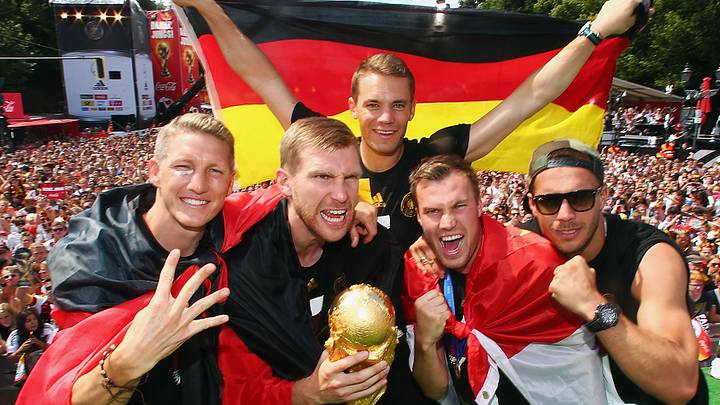
There has been a long list of World Cup winners who have graced the marble halls of Highbury or stepped onto the turf at the Emirates, whether they won the tournament while at the club or arrived as reigning world champions.
We look at the players who won the World Cup while registered as Arsenal players, not those who lifted the trophy before joining or after leaving the Gunners. All players registered on the list will have to be contracted to the club at the moment they could call themselves a world champion.
Arsenal players who won the World Cup
Legends have graced the club, and you have to go back to the 1966 World Cup to find the first Arsenal player who was under contract with the North London side when they became world champions. The 1998 World Cup in France produced more Arsenal winners, followed by further triumphs for representatives at the 2010 and 2014 tournaments.
Player | Country | WC winning year | Arsenal years | Appearances at tournament |
|---|---|---|---|---|
George Eastham | England | 1966 | 1960-1966 | 0 |
Emmanuel Petit | France | 1998 | 1997-2000 | 6 |
Patrick Vieira | France | 1998 | 1996-2005 | 2 |
Cesc Fabregas | Spain | 2010 | 2003-2011 | 4 |
Mesut Ozil | Germany | 2014 | 2013-2021 | 7 |
Per Mertesacker | Germany | 2014 | 2011-2018 | 7 |
Lukas Poldolski | Germany | 2014 | 2012-2015 | 2 |
David Raya | Spain | 2026 | 2023- | 0 |
Mikel Merino | Spain | 2026 | 2024- | 8 |
Martin Zubimendi | Spain | 2026 | 2025- | 1 |
As many will know, England, captained by Bobby Moore, won the 1966 World Cup on home soil with a 4-2 victory over West Germany. George Eastham was part of the squad while at Arsenal, but because he did not play a single minute, he was not awarded a winners' medal at the time. It also proved to be his final tournament as an Arsenal player, with him joining Stoke City just weeks later.
The next Arsenal World Cup winners came at the iconic 1998 final at the Stade de France, where Emmanuel Petit and Patrick Vieira both starred in France's 3-0 victory over Brazil. With France already leading through Zinedine Zidane's brace, Vieira set up Petit to score the third and seal the triumph, and set up the iconic of kneeling together knowing they are world champions.
Both went on to enjoy legendary careers in North London, playing key roles in Arsenal's 1997/98 Double-winning side. It is also worth noting that Thierry Henry and Robert Pirès were part of France's World Cup-winning squad before joining Arsenal in 1999 and 2000 respectively.
There was a gap between Arsenal World Cup winners as Brazil triumphed in 2002 and Italy in 2006, but the club was represented when Spain lifted the trophy for the first time in 2010. Cesc Fàbregas featured twice during the tournament, with Spain favouring Barcelona's midfield trio, but he made his mark in the final by assisting Andrés Iniesta's extra-time winner against the Netherlands.
Fàbregas left Arsenal a year later to rejoin his boyhood club, Barcelona, where he added more silverware to his collection. Although his later move to Chelsea left a sour taste for many Arsenal supporters, his contributions in red remain worthy of celebration.
The 2014 World Cup in Brazil promised Joga Bonito but ended in heartbreak and Brazilian tears for the hosts, with two of Germany's Arsenal contingent playing key roles in their triumph. The defining moment came in the semi-final, when Germany stunned Brazil with an unforgettable 7-1 victory in Belo Horizonte, scoring five in the first half with Mesut Özil playing his part in the thrilling football.
The attacking midfielder started that historic win, while Per Mertesacker came off the bench. Both players also featured in the final in those roles as Germany defeated Argentina 1-0 after extra time to lift the trophy. Lukas Podolski was also part of Joachim Löw's squad, although he played only a limited role, making his appearances earlier in the tournament.
No World Cup winners at Arsenal since the Germans, however there are a long list of credible chances for the world trophy this time around, especially with William Saliba of France, Gabriel Magalhães of Brazil and the England quartet in the squad. We will see if we can add and adapt this article next time around with success growing at the club
Which World Cup-winning Arsenal squad was the most successful?
The obvious choice is the 2014 German squad as that stands out as Arsenal's most successful World Cup contingent, producing a record three winners at a single tournament: Mesut Özil, Per Mertesacker, and Lukas Podolski., all of which featured.
While the iconic 1998 French era saw teammates Patrick Vieira and Emmanuel Petit famously combine for a goal in the final, it only yielded two active Arsenal winners. That French squad also contributed to Arsenal’s legacy in the future years, with Thierry Henry and Robert Pires joining in the years after.
In contrast, Germany's 2014 triumph highlighted the strength of Arsène Wenger's later squads, seeing three Gunners lift the trophy together and cementing that specific tournament as the absolute peak of Arsenal's international success.
Arsenal's history of producing World Cup winners
Arsenal holds a uniquely proud record within English football when it comes to glory on the international scene. Across the history of the FIFA World Cup, ten players have lifted the famous trophy while actively representing the North London club. This legacy truly began to flourish during the late 1990s and early 2010s under Arsène Wenger, whose global recruitment strategy turned the club into a breeding ground for world champions and winning domestic honours in North London.
When compared to other Premier League heavyweights, Arsenal’s international footprint stands at the top of the list, with a total of ten World Cup winners. However, it is West Ham who are the most defining for an England fan, as Bobby Moore was the captain of the England-winning team while Geoff Hurst and Martin Peters were the goalscorers in the final, all registered with the Hammers at the time.
Ultimately, Arsenal's international legacy is not defined by sheer numbers alone, but by the impact they have had for their respective nations on the grandest stage of football
 Add us as a preferred source on Google