%20rotate(-8.06)%22%2F%3E%0A%20%20%3Cpolygon%20class%3D%22cls-1%22%20points%3D%22336.19%20136.81%20330.16%2094.25%20326.06%2071.19%20326.44%2071.13%20335.22%2093.54%20352.29%20134.52%20373.95%20131.46%20362.7%2052.01%20350.02%2053.8%20356.05%2096.36%20360.15%20119.42%20359.77%20119.48%20350.99%2097.08%20333.91%2056.09%20312.25%2059.15%20323.51%20138.6%20336.19%20136.81%22%2F%3E%0A%20%20%3Cpolygon%20class%3D%22cls-1%22%20points%3D%22402.91%2059.3%20412.36%20126.02%20427.17%20123.92%20417.72%2057.21%20431.59%2055.24%20429.79%2042.51%20387.23%2048.53%20389.04%2061.27%20402.91%2059.3%22%2F%3E%0A%20%20%3Cpolygon%20class%3D%22cls-1%22%20points%3D%22463.51%20118.77%20458.69%2084.71%20474.68%2082.44%20479.51%20116.5%20494.36%20114.4%20483.11%2034.95%20468.26%2037.06%20472.96%2070.25%20456.96%2072.52%20452.26%2039.32%20437.4%2041.43%20448.65%20120.88%20463.51%20118.77%22%2F%3E%0A%20%20%3Cpolygon%20class%3D%22cls-1%22%20points%3D%22540.5%20107.87%20538.77%2095.68%20518.91%2098.49%20515.77%2076.29%20535.63%2073.47%20533.93%2061.5%20514.07%2064.32%20511.11%2043.42%20530.98%2040.61%20529.25%2028.42%20494.53%2033.34%20505.78%20112.78%20540.5%20107.87%22%2F%3E%0A%20%20%3Cpolygon%20class%3D%22cls-1%22%20points%3D%22299.03%20155.17%20301.29%20171.58%20542.78%20138.39%20540.5%20121.97%20299.03%20155.17%22%2F%3E%0A%3C%2Fsvg%3E)

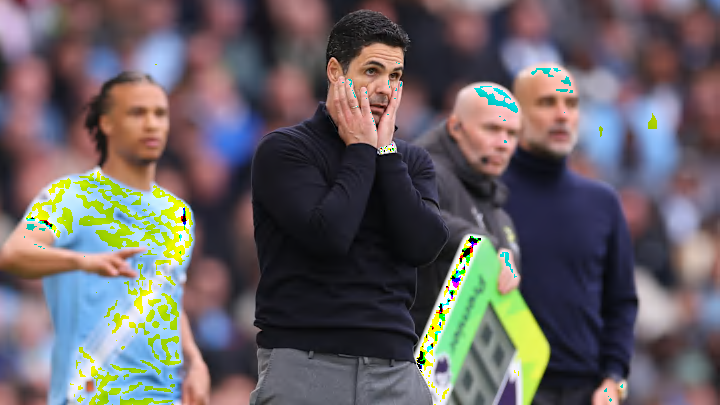
It's not over yet, but Arsenal's Premier League title challenge is on life support after the Gunners failed to land enough gloves on closest rivals Manchester City. Goals from Rayan Cherki and Erling Haaland proved enough to condemn Arsenal to a critical 2-1 defeat at the Eithad Stadium on Sunday, April 19, a result that brought home some harsh truths about Mikel Arteta's reign, albeit with a couple of woefully thin silver linings.
When the only thing his team could muster was a Kai Havertz goal, courtesy of a howler from City goalkeeper Gianluigi Donnarumma, it's easy to see where the blames lies for defeat. Look no further than the touchline, where Arteta paced, hopped, clutched his head, crumpled to his knees and ultimately surrendered to watching a depressingly familiar pattern repeat itself.
The pattern owes a lot to key flaws in Arteta's approach to the job. As well as how the club ceded power to a novice gaffer whose influence has gone unchecked for too long.
Positives & negatives from Arsenal's critical 2-1 defeat away vs. Manchester City
Positive #1: Some long (long) overdue pressure on the manager

Going from being well positioned to win a quadruple of trophies (or more realistically two or three), to potentially ending yet another season empty handed should have Arteta answering plenty of uncomfortable questions.
It's high time the 44-year-old was made to take some blame. Preferably, pressure from within a club content for too long to let a first-time manager have a free hand to rebuild, reset, rebuild again and consistently fall short.
Arteta will have been seven years in the job this December, but this is his sixth full campaign in charge, yet little is changing. More aptly, too many problematic things are staying the same.
Things like Arsenal running out of steam and ideas after half-time in big games. The way Arteta's players did during the Carabao Cup final defeat to City in March.
This pattern was obvious during the rematch in the league. City attacked the second period with greater energy and purpose.
That this keeps happening is a sign of two things. Neither of them to the manager's credit.
Arteta is being out-thought by his oppositie numbers. Shrewder managers like City chief Pep Guardiola, who used the intermission to adjust in a way Arteta still finds difficult to match.
Second, Arsenal's disappoining stamina during the business end of critical matches is an indictment of how Arteta manages the physical levels of his players. Whether it's over-training or a lack of squad rotation, the result is the same year after year.
Key players break down and are nursing injuries for the games that matter most. Those who are available, tend to wilt under the weight of exertion, retreating deep and playing a passive brand of football that reflects Arteta's generally negative tactics.
Arteta has gotten by for too long on the promise of the "project" reaching its most important phase, whatever number that might represent. Members of the Arsenal hierarchy have simply taken it for granted Arteta will deliver, no matter how often he fails to correct obvious issues.
If that changes, it can only be good for Arsenal in the long-term. Or else those in charge risk another near-decade of heavy investment for little return and familiar disappointments.
Negative #2: Arsenal still need goalscorers

One of the longstanding issues Arteta still hasn't addressed is the lack of natural goalscorers in his squad. The problem was summed up the erratic day endured by Havertz.
He began well, harrying defenders and dropping into unfamiliar territory to pull City's back line out of position. The intelligence and industry yielded a reward when Havertz pressed a far too casual Donnarumma and deflected his late clearance over the line.
Havertz had demonstrated the endeavour and initiative Arsenal needed in City's back yard, but the nature of his goal revealed a problem Arteta can't shift. Even after throwing a ton of money at the issue.
The fact the only goal his team scored in a game Arsenal simply couldn't lose was a deflection from a self-destructive moment of madness, sums up the lack of quality the Gunners posses in the final third.
Havertz became an emblem for this lack of quality when he shot straight at Donnurmma to waste one promising break. Then a stoppage-time header from point-blank range didn't even force a save.
A true goalscorer takes one, if not both, of those chances. Havertz isn't one, despite costing £65 million. Arteta also doesn't believe Viktor Gyökeres fits the label, at least based on the curious decision to leave the £64 million actual striker on the bench for Arsenal's biggest league game in years.
The bench was also populated by ex-City frontman Gabriel Jesus, another pricey Arteta buy (£45 million) who hasn't solved problems in front of goal. Arteta was allowed to ditch Pierre-Emerick Aubameyang in early 2022 as a supposed culture reset, but the manager hasn't come close to finding another goalscorer as capable since.
It hasn't helped Arteta also hasn't put enough talent behind his strikers.
Negative #2: Martin Odegaard off the pace

Odegaard's return to the lineup was supposed to be the boost Arsenal needed for this potential title decider. Instead, the playmaker was decidedly off the pace, and his struggles hampered the Gunners going forward.
Rust has gathered during the months Odegaard has been on the treatment table. He couldn't shake it off against City, overhitting too many passes, producing poor angles on others and not showing enough bravery to play forward between the lines.
Odegaard's wonky radar meant he was outplayed by City's schemers, particularly an industrious Bernardo Silva. The latter is a timeless worker bee who matches effort with skill, but Silva also benefits from playing alongside other forward-thinking and cultured passers.
There is no such support for Odegaard, who must regain his sharpness fast if Arsenal have any chance to still claim the prize.
Positive #2: It's Not Over yet

Looking for that silver lining. Well, here goes. The remaining fixtures are laid out it in such a way that Arsenal can still win this Premier League title.
It's true City will go top with a win at relegation-threatened Burnley on Wednesday. That's the bad news, but City's involvement in the FA Cup means Arsenal will play twice before their rival sees league action again, a difficult away trip to Everton on Monday, May 4.
Before then, home games against Newcastle United and Fulham give Arsenal two chances to wrest back control of the race. Or at least put the pressure on City for a change.
Doing so will require more impetus going forward and braver tactics from a manager who must remember why he bought Gyökeres, and why Odegaard needs more support in the creative department.
 Add us as a preferred source on Google