%20rotate(-8.06)%22%2F%3E%0A%20%20%3Cpolygon%20class%3D%22cls-1%22%20points%3D%22336.19%20136.81%20330.16%2094.25%20326.06%2071.19%20326.44%2071.13%20335.22%2093.54%20352.29%20134.52%20373.95%20131.46%20362.7%2052.01%20350.02%2053.8%20356.05%2096.36%20360.15%20119.42%20359.77%20119.48%20350.99%2097.08%20333.91%2056.09%20312.25%2059.15%20323.51%20138.6%20336.19%20136.81%22%2F%3E%0A%20%20%3Cpolygon%20class%3D%22cls-1%22%20points%3D%22402.91%2059.3%20412.36%20126.02%20427.17%20123.92%20417.72%2057.21%20431.59%2055.24%20429.79%2042.51%20387.23%2048.53%20389.04%2061.27%20402.91%2059.3%22%2F%3E%0A%20%20%3Cpolygon%20class%3D%22cls-1%22%20points%3D%22463.51%20118.77%20458.69%2084.71%20474.68%2082.44%20479.51%20116.5%20494.36%20114.4%20483.11%2034.95%20468.26%2037.06%20472.96%2070.25%20456.96%2072.52%20452.26%2039.32%20437.4%2041.43%20448.65%20120.88%20463.51%20118.77%22%2F%3E%0A%20%20%3Cpolygon%20class%3D%22cls-1%22%20points%3D%22540.5%20107.87%20538.77%2095.68%20518.91%2098.49%20515.77%2076.29%20535.63%2073.47%20533.93%2061.5%20514.07%2064.32%20511.11%2043.42%20530.98%2040.61%20529.25%2028.42%20494.53%2033.34%20505.78%20112.78%20540.5%20107.87%22%2F%3E%0A%20%20%3Cpolygon%20class%3D%22cls-1%22%20points%3D%22299.03%20155.17%20301.29%20171.58%20542.78%20138.39%20540.5%20121.97%20299.03%20155.17%22%2F%3E%0A%3C%2Fsvg%3E)

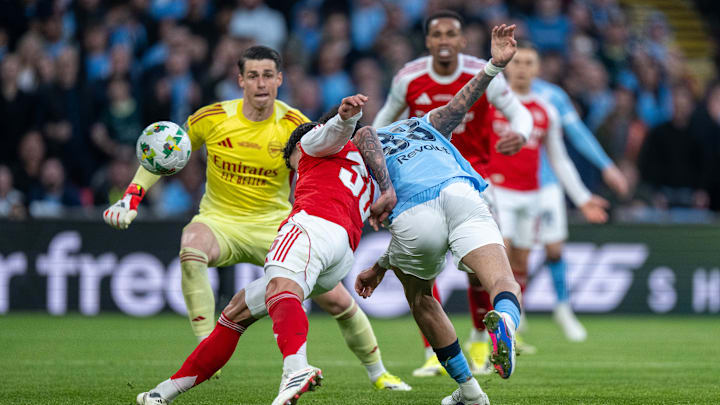
The 'Quadruple' was always an unrealistic aim for Arsenal, but it's officially now a non-starter after the Gunners fell flat against Manchester City in the 2026 EFL Carabao Cup final. Two headers by Nico O'Reilly justly punished a timid and negative second-half display bereft of attacking creativity and intent.
A lot of the blame will fall on Mikel Arteta's choice to hand backup goalkeeper Kepa Arrizabalaga a start ahead of David Raya, but there'll be none of that here. Granted, Kepa dropping a cross gifted O'Reilly the opening goal on the hour mark, but familiar problems did more to condemn Arsenal to defeat than team selection.
The selection argument is wafer-thin when City kept a clean sheet despite being denied the services of regular centre-back partnership Ruben Dias and Marc Guéhi because of injury and ineligibility issues. Arsenal's own injury problems also impacted Arteta's team selections, particularly in creative areas, although the manager can't escape criticism for failing to properly support an initially lively Viktor Gyökeres.
Positives & negatives from Arsenal's dismal 2-0 Carabao Cup final defeat vs. Manchester City
Positive #1: Direct Viktor Gyökeres

Arteta had the right plan for both Gyökeres and City early in the game. Put simply, it was to fire long balls into the channels for the bullish striker to chase and hold up.
The plan worked because it ticked two important boxes for Arsenal. First, it got City's back line turned and chasing pace in behind, an area where Pep Guardiola's defence has struggled mightily in recent weeks.
Second, going direct is one half of the formula for getting the best out of Gyökeres. He needs the ball quickly, delivered with no wasted motion.
That's just what Arsenal did during the opening 20 minutes. Arteta's players took two passes at the most to release the frontman, who ran the channels well, muscled defenders and always stayed committed to his task.
Unfortunately, Gyökeres' graft went without reward because Arteta and the Gunners didn't get the other half of the equation right.
Negative #1: Kai Havertz failed No. 10 audition

Injuries to Martin Odegaard and Eberechi Eze forced Arteta into a rethink about the team's lone central conductor in the final third. Sadly, Arteta's thinking led him astray and into putting Kai Havertz in this crucial position.
Havertz couldn't get on the ball enough, and on the rare occasions he did, the German's touch let him down and his vision was found wanting. A bigger problem was how Havertz went about operating as the closest player to Gyökeres.
What Havertz opted to do was play more like a central midfielder than a second forward. The latter is how Eze was playing alongside Gyökeres.
A bolder approach from Arteta might've involved starting Gabriel Jesus and playing two up top. Jesus' tendency to drift right could have been indulged by putting Bukayo Saka on the left to target City's winger-turned right-back Matheus Nunes.
Instead, Arteta played it safe and the result was a passive brand of football that not only highlighted Havertz's flaws. It also contributed to Arsenal wasting their promising, early direct approach.
Negative #2: Arteta mis-managed momentum

You can almost set the clock on your phone to one of the common weaknesses of this Arsenal team. It stems from Arteta being slow to unveil a plan B.
The eternal hipsters' manager of choice is nothing if not a fountain of ideas, but if Arteta's latest tactical tweak doesn't work early enough, his team soon falls flat. It happened at Wembley Stadium after the direct route to Gyökeres had stressed City's defenders, but not breached their goal.
Arsenal lacked alternatives and soon slipped back into bad habits. Familiar flaws like overplaying at the back, taking too long to build forward attacks and re-establish and maintain momentum.
Getting the Big Mo' back will be vital if the Gunners are going to stage a quick recovery from this setback and stay on track to end their silverware drought. Fortunately, Arteta has enough of the right players to believe another blip against City won't prove fatal.
Positive #2: Arsenal have right leaders to maintain trophy hunt

Delivering a performance this drab on such a big stage routinely dented Arsenal teams of the past, and you don't need to travel too far back in history for obvious examples.
The infamous 2-2 draw with Birmingham City in 2008 unravelled the legitimate title hopes of Arsène Wenger's best team of the Emirates Stadium era. Losing to the same opposition in the Carabao Cup final three years later derailed an enterprising squad that had, like this one, been credibly competing on all four fronts.
That's the history Arteta and the 2025/26 team is battling against, but there's good reson to believe this group won't break. While those teams were undermined by the petulance of William Gallas, the above-the-fray sulking of Robin van Persie and the aloofness of Samir Nasri and Andrey Arshavin, this Arsenal collective features some stronger voices.
It isn't a stretch to imagine a snarling rant from Gabriel Magalhaes, or a rallying cry from Declan Rice, prompting this group to quickly reset. A swift turnaround is needed when Arsenal remain viable in both the FA Cup and UEFA Champions League, thanks in no small part to the kindness of the draws, as well having one hand on the Premier League title.
Winning any one of the two big prizes would represent a narrative-changing success, both for the club and Arteta. Seizing two of the three trophies still available, a reasonable goal, would completely erase the memory of handing the initiative to City at Wembley.
It will require sticking together, and that sense of unity will come from the most vocal members of the team. Letting Rice and Gabriel do the talking can keep Arsenal on course.
 Add us as a preferred source on Google