%20rotate(-8.06)%22%2F%3E%0A%20%20%3Cpolygon%20class%3D%22cls-1%22%20points%3D%22336.19%20136.81%20330.16%2094.25%20326.06%2071.19%20326.44%2071.13%20335.22%2093.54%20352.29%20134.52%20373.95%20131.46%20362.7%2052.01%20350.02%2053.8%20356.05%2096.36%20360.15%20119.42%20359.77%20119.48%20350.99%2097.08%20333.91%2056.09%20312.25%2059.15%20323.51%20138.6%20336.19%20136.81%22%2F%3E%0A%20%20%3Cpolygon%20class%3D%22cls-1%22%20points%3D%22402.91%2059.3%20412.36%20126.02%20427.17%20123.92%20417.72%2057.21%20431.59%2055.24%20429.79%2042.51%20387.23%2048.53%20389.04%2061.27%20402.91%2059.3%22%2F%3E%0A%20%20%3Cpolygon%20class%3D%22cls-1%22%20points%3D%22463.51%20118.77%20458.69%2084.71%20474.68%2082.44%20479.51%20116.5%20494.36%20114.4%20483.11%2034.95%20468.26%2037.06%20472.96%2070.25%20456.96%2072.52%20452.26%2039.32%20437.4%2041.43%20448.65%20120.88%20463.51%20118.77%22%2F%3E%0A%20%20%3Cpolygon%20class%3D%22cls-1%22%20points%3D%22540.5%20107.87%20538.77%2095.68%20518.91%2098.49%20515.77%2076.29%20535.63%2073.47%20533.93%2061.5%20514.07%2064.32%20511.11%2043.42%20530.98%2040.61%20529.25%2028.42%20494.53%2033.34%20505.78%20112.78%20540.5%20107.87%22%2F%3E%0A%20%20%3Cpolygon%20class%3D%22cls-1%22%20points%3D%22299.03%20155.17%20301.29%20171.58%20542.78%20138.39%20540.5%20121.97%20299.03%20155.17%22%2F%3E%0A%3C%2Fsvg%3E)

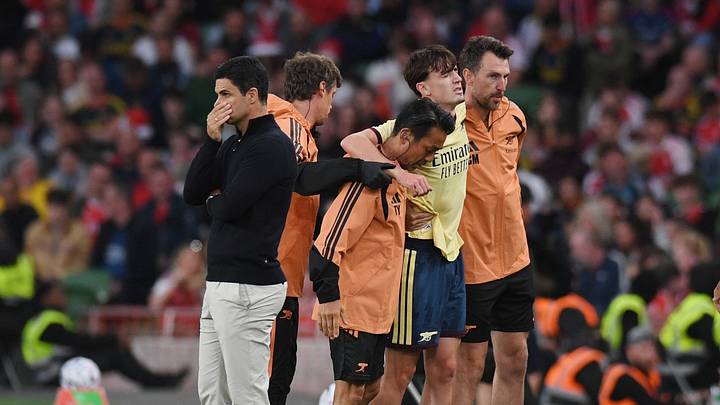
Every season, Arsenal fans seem to have the same conversation about injuries. It is almost hard wired into the supporter psychology that the Gunners suffer more than most when it comes to players being ruled out and key stars missing games.
Last season, though, the numbers appear to back up that long held belief. Data from leading injury analysts Premier Injuries paints a worrying picture of Arsenal's injury burden during their title winning campaign, with the Gunners among the Premier League clubs to suffer the most injuries and lose the most time to absences.
At first glance, it suggests the club struggled to manage the physical demands placed upon its squad. But there is more to the story than the headline numbers, and when Arsenal's enormous workload is taken into account, the picture becomes considerably more complicated.
Below I will analyse what we can learn from the new data and how worried fans should be if it hinders the abilities of the team to defend their Premier League crown.
The injury numbers make grim reading
Looking at the data from the newly published report from Premier Injuries and the numbers jump out at you. There is no getting away from the fact that Arsenal suffered a significant injury burden. Scanning through the facts and Arsenal had 36 “time-loss injuries” across the campaign. Premier Injuries define time loss injuries as “Any injury that results in a player missing at least one competitive fixture”.
To put that into context, that means that Arsenal had the third highest total time-loss injuries only behind Tottenham and Chelsea. This was also 8.3 more than the Premier League average, showing how much of an outlier the club was in terms of total injuries.
The picture becomes even more concerning when looking beyond the headline injury count. Arsenal's absences accounted for 1,115 days lost and 128 games missed, placing them among the clubs with the highest overall injury burden in the division.
Plus, these were not simply fringe players missing the occasional fixture. Arsenal were repeatedly forced to cope without some of the most important players in Mikel Arteta's squad. Bukayo Saka, Martin Ødegaard, Kai Havertz, Jurrien Timber, Mikel Merino and Ben White all endured significant spells on the sidelines at different points of the campaign.
The consequences were felt on the pitch. Injuries forced Mikel Arteta to alter his line-ups, adjust his tactical approach and rely on players in unfamiliar roles. Some of the absences hit especially hard impacting important moments of the season.
For players such as Saka and Ødegaard, the problem was also not simply one isolated absence. Repeated interruptions to their seasons made it more difficult to build consistency and rhythm, adding another layer to the impact of Arsenal's injury problems.
One piece of data changes the story
However, it is not all doom and gloom. There is another statistic within the Premier Injuries data that offers a more positive perspective.
Rather than simply counting the number of injuries suffered by each club, the report also measures injury incidence per 1,000 minutes played. This is a useful way to add much needed context to injury data as it helps account for the amount of football each squad was actually exposed to. In this way there is a fairer comparison between clubs with vastly different workloads. On this measure, Arsenal's numbers look considerably less alarming.
Due to Arsenal getting to two huge finals, going all the way in the Champions League and Carabao Cup, the Gunners recorded an injury incidence rate of 6.5 injuries per 1,000 minutes played, compared with a Premier League average of 6.2. Arsenal were therefore only around five per cent above the league-wide figure, despite recording the third-highest total number of time-loss injuries.
That context is important. The squad had an incredibly high exposure rate with the most minutes played of all teams in the league, therefore had considerably more opportunity to accumulate injuries than the average Premier League side. Their sixth position for injuries per 1,000 minutes played therefore feels less concerning as we can expect more injuries the more often you play.
Questions still need to be asked
Although the data is better when put into the context of exposure it should also not completely absolve Arsenal of responsibility for their injury record. Their 6.5 incidence rate was still above the league average, in the top 7, and elite rivals operating under similarly demanding schedules managed to record lower figures.
In fact when looking at Arsenal’s two biggest title rivals, Liverpool and Manchester City the teams results are not comparable. Liverpool recorded an injury incidence of 6.0 per 1,000 minutes, while Manchester City were lower still at 5.0. Arsenal. Both clubs also carried similarly significant workloads across the season, meaning the Gunners cannot simply point to their packed schedule as the sole explanation for their higher injury rate.
What it does show, however, is that there is room for Arsenal to improve. There is definitely capacity when comparing themselves to other similarly sized teams with squads that are going for all trophies each season.
Liverpool, for example, have invested in using AI to help monitor player wellbeing and act as a “autopilot” to flag potential injuries to players. Manchester City have similarly developed a highly integrated approach in which medical staff work closely with sports scientists to monitor workload, tailor training and manage players differently according to their injury history and recent physical demands.
The point is not that Arsenal need to copy either club. But it can look to learn. Football is all about marginal gains, and so small improvements in player availability can have a significant impact.
Positive signs for the new season
From the outside, Arsenal appear determined to improve their injury record. The club has made significant changes to its medical and performance operation over the summer, with Dr Zafar Iqbal departing his role and Dr Arnaldo Abrantes arriving as his replacement. Arsenal have also added further expertise to their rehabilitation and performance departments, including Eneko Angulo from Real Betis, as the club looks to strengthen an already well equipped backroom operation.
Those changes do not, of course, prove that Arsenal's previous injury problems were the responsibility of any one individual. Nor can any club realistically eliminate injuries from a season in which it is competing at the highest level across multiple competitions. By its very nature football is a contact sport, accidents will happen as well as fatigue related injuries. But the decision to make significant changes suggests Arsenal are not simply accepting last season's numbers as an inevitable consequence of their workload.
There is also another factor that should not be overlooked when assessing what comes next. A huge psychological boost. Last season was Arsenal's first Premier League title win in 22 years. The pressure surrounding the club throughout that campaign was therefore enormous, with every setback carrying additional weight as Mikel Arteta's side attempted to finally get over the line. They succeeded, and that achievement could alter the psychological landscape heading into the new season.
This group of players now know it can win titles, and because of this there may be less of the uncertainty and external pressure that accompanied last season's title pursuit. That does not make injuries less likely, but a squad that has already broken that particular barrier may be better equipped mentally to deal with setbacks without allowing them to become an overriding narrative.
Finally, Arsenal also enter the new campaign with a deeper squad. The club has continued to strengthen its options, while the emergence of players capable of stepping into important roles gives Arteta more flexibility when injuries do occur. That could ultimately prove just as important as reducing the number of injuries themselves.
For these reasons Arsenal fans can be happy that the club are being proactive in trying to sort out the clubs issues. There is no complacency, rather there is a drive towards perfection.
 Add us as a preferred source on Google