%20rotate(-8.06)%22%2F%3E%0A%20%20%3Cpolygon%20class%3D%22cls-1%22%20points%3D%22336.19%20136.81%20330.16%2094.25%20326.06%2071.19%20326.44%2071.13%20335.22%2093.54%20352.29%20134.52%20373.95%20131.46%20362.7%2052.01%20350.02%2053.8%20356.05%2096.36%20360.15%20119.42%20359.77%20119.48%20350.99%2097.08%20333.91%2056.09%20312.25%2059.15%20323.51%20138.6%20336.19%20136.81%22%2F%3E%0A%20%20%3Cpolygon%20class%3D%22cls-1%22%20points%3D%22402.91%2059.3%20412.36%20126.02%20427.17%20123.92%20417.72%2057.21%20431.59%2055.24%20429.79%2042.51%20387.23%2048.53%20389.04%2061.27%20402.91%2059.3%22%2F%3E%0A%20%20%3Cpolygon%20class%3D%22cls-1%22%20points%3D%22463.51%20118.77%20458.69%2084.71%20474.68%2082.44%20479.51%20116.5%20494.36%20114.4%20483.11%2034.95%20468.26%2037.06%20472.96%2070.25%20456.96%2072.52%20452.26%2039.32%20437.4%2041.43%20448.65%20120.88%20463.51%20118.77%22%2F%3E%0A%20%20%3Cpolygon%20class%3D%22cls-1%22%20points%3D%22540.5%20107.87%20538.77%2095.68%20518.91%2098.49%20515.77%2076.29%20535.63%2073.47%20533.93%2061.5%20514.07%2064.32%20511.11%2043.42%20530.98%2040.61%20529.25%2028.42%20494.53%2033.34%20505.78%20112.78%20540.5%20107.87%22%2F%3E%0A%20%20%3Cpolygon%20class%3D%22cls-1%22%20points%3D%22299.03%20155.17%20301.29%20171.58%20542.78%20138.39%20540.5%20121.97%20299.03%20155.17%22%2F%3E%0A%3C%2Fsvg%3E)

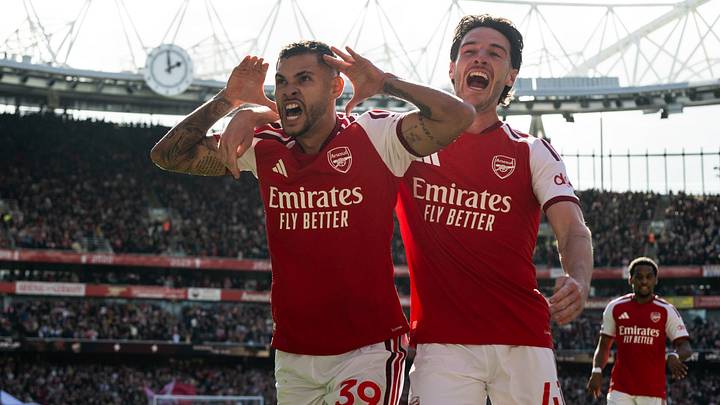
Arsenal fans have been given a taste of what their new-look midfield could produce over the course of the season in the last few days.
On Saturday against Leeds United, Bruno Guimaraes' introduction changed the game, releasing the shackles on Arsenal's rigidity in the middle of the park. On Tuesday against Lille, the Gunners were transformed after Martin Odegaard was brought on in place of Mikel Merino.
While neither Merino nor Myles Lewis-Skelly (the two players who were sacrificed in these matches) were playing inherently poorly, the North Londoners' midfield was undoubtedly elevated by these changes. The trio on the pitch at the end of these games felt like Mikel Arteta's first choice, and Arsenal now have something to build on in the middle of the park moving forward.
PSG's midfield is the standard
Over the last two seasons, Paris Saint-Germain's midfield trio of Vitinha, Joao Neves and Fabian Ruiz have set the standard in European football. Not only are all three extremely talented footballers in their own right, but the unique tactical make-up of them being deployed together has been a key part of Luis Enrique's team's success.
Traditionally in three-man midfields, players have defined roles. One will be tasked with stopping the opposition from threatening the team's backline, another will primarily be responsible for creating chances in the final third, and the other will do a bit of both, alongside some ball progression.
While there has historically been some flexibility regarding where the players fulfilling each of these roles stand (N'Golo Kante was often an advanced ball winner, while Cesc Fabregas was often a creative player from deep), generally they all have fixed positions in the middle of the park and don't deviate.
PSG's midfield has defied these norms. Vitinha, Neves and Ruiz are all capable of doing all these different jobs to a high level, and they're granted the freedom by Enrique to move about as they carry out these various roles.
Sometimes you'll see Ruiz collecting the ball off the centre-backs while Neves breaks into the box further up the pitch. Sometimes Vitinha will be orchestrating the build-up while Neves presses and Ruiz looks to create further forward.
The multi-faceted skill set of each of the three players, combined with their positional rotations, has allowed PSG to become more unpredictable, while also allowing all three midfielders to react to the game around them without being bound by positional rigidity.
Arsenal can now replicate PSG's midfield
In 2024/25, Arsenal's midfield became far too inflexible. Thomas Partey's inability to move outside of a small radius in the middle of the pitch meant his role as the first receiver from the defence was far too defined. The Ghanaian was never seen anywhere but in deep central areas.
This meant Declan Rice had to adapt and learn to play a box-crashing role, while Odegaard remained in his right-half space for the full 90 minutes.
Last season, when Odegaard was fit, Arsenal tried to implement a much more flexible midfield system with Martin Zubimendi. This worked well at times, but with the Norwegian often replaced by Eberechi Eze due to injury issues, the Gunners weren't able to instill the PSG model very often.
With Guimaraes, they can do it all the time. All three players are excellent passers from deep. All three can create chances, can crash the box and facilitate attacking play in the final third. Odegaard may not be the best defender, but he can lead the press from the front, as can the other two.
All are athletic enough to play in this free-flowing, positionless system, and it has the potential to be even better than PSG's version.
 Add us as a preferred source on Google