%20rotate(-8.06)%22%2F%3E%0A%20%20%3Cpolygon%20class%3D%22cls-1%22%20points%3D%22336.19%20136.81%20330.16%2094.25%20326.06%2071.19%20326.44%2071.13%20335.22%2093.54%20352.29%20134.52%20373.95%20131.46%20362.7%2052.01%20350.02%2053.8%20356.05%2096.36%20360.15%20119.42%20359.77%20119.48%20350.99%2097.08%20333.91%2056.09%20312.25%2059.15%20323.51%20138.6%20336.19%20136.81%22%2F%3E%0A%20%20%3Cpolygon%20class%3D%22cls-1%22%20points%3D%22402.91%2059.3%20412.36%20126.02%20427.17%20123.92%20417.72%2057.21%20431.59%2055.24%20429.79%2042.51%20387.23%2048.53%20389.04%2061.27%20402.91%2059.3%22%2F%3E%0A%20%20%3Cpolygon%20class%3D%22cls-1%22%20points%3D%22463.51%20118.77%20458.69%2084.71%20474.68%2082.44%20479.51%20116.5%20494.36%20114.4%20483.11%2034.95%20468.26%2037.06%20472.96%2070.25%20456.96%2072.52%20452.26%2039.32%20437.4%2041.43%20448.65%20120.88%20463.51%20118.77%22%2F%3E%0A%20%20%3Cpolygon%20class%3D%22cls-1%22%20points%3D%22540.5%20107.87%20538.77%2095.68%20518.91%2098.49%20515.77%2076.29%20535.63%2073.47%20533.93%2061.5%20514.07%2064.32%20511.11%2043.42%20530.98%2040.61%20529.25%2028.42%20494.53%2033.34%20505.78%20112.78%20540.5%20107.87%22%2F%3E%0A%20%20%3Cpolygon%20class%3D%22cls-1%22%20points%3D%22299.03%20155.17%20301.29%20171.58%20542.78%20138.39%20540.5%20121.97%20299.03%20155.17%22%2F%3E%0A%3C%2Fsvg%3E)

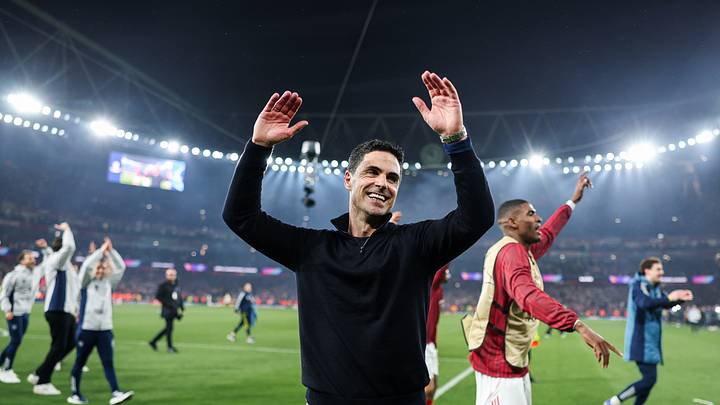
They once tried to be the great entertainers on both fronts, the English Premier League and the UEFA Champions League, but Arsenal have finally accepted the boring, but brilliant truth about winning in Europe.
Mikel Arteta knows his team has mastered boring brilliance after watching Arsenal protect a ninth clean sheet in 14 Champions League games this season. The Gunners' latest shutout was enough to beat Atletico Madrid 1-0 in the semi-final second leg and confirm a place in the final for the first time in 20 years.
Arsenal will arrive in Budapest on Saturday, May 31 having progressed in the time-honoured fashion of winning on the continent.
Arsenal's negativity a positive in Europe
The Arsenal of Arteta's era is far from pleasing on the eye. He's created a defensive machine that operates more efficiently out of possession than with the ball.
The artristry of Arsene Wenger's day has been replaced by relentless running, a spoiling press and a resolute low block. It's not the Beautiful Game, but there's something beautiful about its effectiveness. Something beautiful about conceding just six goals en route to this final.
It's not for the purisits, but this vintage of Arsenal is better suited to the demands of the Champions League. There is a misnomer about football at the highest level on the continent, the level of the star names and ultra-expensive attacking talent, but a level where football is more tactical, more cautious, more about absorbing pressure and striking back on the counter.
All of these requirements demand structure, discipline and at least equal energy tracking back as raiding forward. In other words, all of the things that were the antithesis of the expansive and buccaneering free-form jazz Wenger prized like a badge of honour.
There are exceptions, but the history of European cup competitions has mostly been dominated by streetwise teams and managers willing to sacrifice purity for pragmatism. Think Jose Mourinho parking the bus and using every bit of gamesmanship from the pages of the dark arts manual. Rafa Benitez won European trophies with Valencia, Liverpool and Chelsea because he knew how to set his teams up to win wars of attrition at the business end of tournaments.
Manchester United's treble winners of 1999 were a notable exception, having enough firepower to conquer Europe's elite, but the Red Devils were more consistently successful in Europe from 2006 onwards. Once Nemanja Vidić, Rio Ferdinand and Edwin van der Sar underpinned a formidable rearguard behind functional and rugged midfields populated by Michael Carrick, Park Ji-sung and Darren Fletcher.
Arsenal were often on the wrong end of European ties because Wenger could never quite bring himself to make similar concessions, but Arteta has no such scruples about what it takes to win in Europe.
Mikel Arteta has found the right Champions League formula
Arteta must be a student of Arsenal history because he's following what worked best for the club on its travels in the past. The Gunners have a modest history in Europe, with the greatest night being a 1-0 win over an enterprising Parma team to win the 1994 UEFA Cup Winners Cup.
It was a victory assured by George Graham, the architect of the famous back four led by Tony Adams and Steve Bould. Graham thought nothing about deploying five at the back and also adding a central defender like Martin Keown or Steve Morrow to midfield to man-mark a creative No. 10 out of a game.
This Arsenal team denied space and refused to buckle while waiting for the ideal opportunity to feast off scraps in attack. Many of those scraps were provided by set-pieces, just like Arteta's team.
Today's Arsenal uses a corner or a well-worked free-kick routine like Wenger's teams used to use a perfectly-weighted through pass to meet an angled, pacy run between the lines. One- and two-touch passes between triangles of technically proficient players have been replaced by forcing turnovers high up the pitch, thanks to a determined press led by midfield hard-charger Declan Rice and increasingly bullish target man Viktor Gyökeres.
The difference between Arsenal's appetite for defending under Arteta, compared with the days of Wenger is obvious. Yet, there are some similarities between this season's Champions League run and the last time the Gunners reached the final, on Wenger's watch in 2006.
That success owed a lot to a makeshift defence featuring youthful duo Emmanuel Eboué and Mathieu Flamini at full-back, while nascent centre-back Philippe Senderos partnered Kolo Touré in the middle. Wenger wisely protected this inexperienced group with five-man midfields built on the 'invisible wall' the criminally underrated Gilberto Silva created in front of the back four.
This defensive dynamic helped Arsenal set records, conceding just twice on the way to the final. Even keeping clean sheets against mighty Real Madrid and Juventus, as well as Manuel Pellegrini's outstanding Villarreal in the knockout phase.
Arteta wasn't part of this journey, but he may have taken notes. At least based on the shape this Arsenal side often adopts out of possession.
It's usually some version of a 4-5-1 with Eberechi Eze or Martin Odegaard dropping deep. Or else Arteta's players form a flat 4-4-2 with the traditional two banks of four, perfect for covering all of the available space and countering with pace on the break.
Denying the opposition's best players the room to create, harassing the less confident on the ball into mistakes, seizing random chances and maximizing set-pieces. It's a formula as old as the game itself, and one that's always worked wonders in Europe.
Arteta's Arsenal have the formula down to a science, but they'll need all their mastery to outlast the power of style kings Bayern Munich or PSG in the final.
 Add us as a preferred source on Google