%20rotate(-8.06)%22%2F%3E%0A%20%20%3Cpolygon%20class%3D%22cls-1%22%20points%3D%22336.19%20136.81%20330.16%2094.25%20326.06%2071.19%20326.44%2071.13%20335.22%2093.54%20352.29%20134.52%20373.95%20131.46%20362.7%2052.01%20350.02%2053.8%20356.05%2096.36%20360.15%20119.42%20359.77%20119.48%20350.99%2097.08%20333.91%2056.09%20312.25%2059.15%20323.51%20138.6%20336.19%20136.81%22%2F%3E%0A%20%20%3Cpolygon%20class%3D%22cls-1%22%20points%3D%22402.91%2059.3%20412.36%20126.02%20427.17%20123.92%20417.72%2057.21%20431.59%2055.24%20429.79%2042.51%20387.23%2048.53%20389.04%2061.27%20402.91%2059.3%22%2F%3E%0A%20%20%3Cpolygon%20class%3D%22cls-1%22%20points%3D%22463.51%20118.77%20458.69%2084.71%20474.68%2082.44%20479.51%20116.5%20494.36%20114.4%20483.11%2034.95%20468.26%2037.06%20472.96%2070.25%20456.96%2072.52%20452.26%2039.32%20437.4%2041.43%20448.65%20120.88%20463.51%20118.77%22%2F%3E%0A%20%20%3Cpolygon%20class%3D%22cls-1%22%20points%3D%22540.5%20107.87%20538.77%2095.68%20518.91%2098.49%20515.77%2076.29%20535.63%2073.47%20533.93%2061.5%20514.07%2064.32%20511.11%2043.42%20530.98%2040.61%20529.25%2028.42%20494.53%2033.34%20505.78%20112.78%20540.5%20107.87%22%2F%3E%0A%20%20%3Cpolygon%20class%3D%22cls-1%22%20points%3D%22299.03%20155.17%20301.29%20171.58%20542.78%20138.39%20540.5%20121.97%20299.03%20155.17%22%2F%3E%0A%3C%2Fsvg%3E)

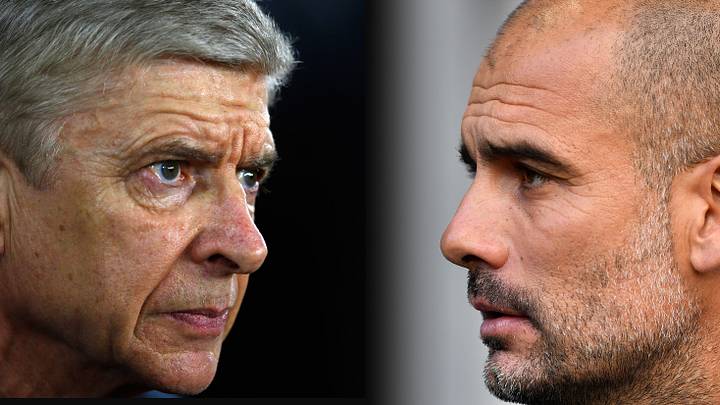
Manchester City have been found guilty on 114 of 115 charges relating to breaches of Premier League regulations, and several clubs, including Arsenal, have therefore been left wondering what might have been had the rules been followed.
Numerous clubs are now planning legal action against City following this guilty verdict. Teams have been relegated, missed out on Champions League football, titles and cups because of the unfair advantage the Citizens have gained from being able to attract players and managers they shouldn't have.
In part 1, we delved into what might've happened at Arsenal each season between 2009 and 2014. Throughout this period, Arsene Wenger managed to keep the Gunners competitive in the top four, despite City's rise from mid-table mediocrity to perennial title challengers.
The same cannot be said for the ensuing period, when Arsenal's downfall began, leading to the point in which Mikel Arteta eventually stepped in to rebuild a broken and fractured club.
With that said, here's a look at what might've happened at Arsenal each season between 2014 and 2018, had City followed the rules. It's entirely guesswork, and there's a lot of projecting and assuming, but here's how the seasons could've entailed for the Gunners.
2014/15
Real finish: 3rd
Probable finish without City charges: 2nd
To set the scene around Arsenal in 2014, the Gunners had just managed to end their nine-year trophy drought by winning the FA Cup, while they'd capitulated in the title race towards the end of the 2013/14 season. However, the summer of 2014 did represent a slight shift in Arsenal's financial situation, with the burden of stadium debt no longer quite as pressing.
That said, the gap between them and City was at this point quite large from a squad perspective. Years of significant investment at the Etihad, compared to years of austerity at the Emirates, had widened the gap, and it was remarkable that Wenger had even kept his team in the vicinity of their north-west counterparts.
Once again, however, Arsenal lost a key player to City this summer. Bacary Sagna swapped North London for Manchester, rejecting a contract offer from the Gunners in favour of a more lucrative proposal from the Citizens.
Alongside the French full-back, City went big on Eliaquim Mangala and Wilfried Bony (in January), further strengthening their title-winning squad.
An Alexis Sanchez-powered Arsenal actually managed to push Pellegrini's men close, finishing just four points behind City, who missed out on the title to Jose Mourinho's Chelsea by eight points. It's safe to say that the Gunners probably would've comfortably beaten City to second without the financial breaches.
At this point, City's accumulation of dubiously sourced talent provided the foundation for their success, rather than the individual bits of business they did in the transfer windows prior to new seasons starting.
2015/16
Real finish: 2nd
Probable finish without City charges: 1st
2015/16 was without doubt the strangest Premier League season in recent times. Leicester City miraculously won the title, while Arsenal finished second on a lowly 71 points, despite evidently not being a particularly impressive side.
It may seem like a stretch to say Arsenal would've won the league this season if City had followed the rules, but there's certainly a case for it. City's ability to exploit the regulations for almost seven years at this point had eroded the quality of the likes of Arsenal, Chelsea, Liverpool and Manchester United. All four teams lost out on players City signed unethically, and their comparitive weakness was reflected in a dry spell for English teams in European competition.
It's very plausible that the Gunners might have still had a prime-aged Samir Nasri in 2015, and even a player of this calibre could've pushed Arsenal much closer to Leicester.
It's not unreasonable to suggest that had the Gunners landed some of the quality players City secured over them, like David Silva and Yaya Toure, they would've accumulated an additional ten points and beaten the Foxes to this title. It's a bit of a stretch, but it's far from an egregious suggestion.
2016/17
Real finish: 5th
Probable finish without City charges: 4th
Strangely, this was both City's worst season in recent times and also the campaign where their misdemeanours hurt Arsenal the most. 2016/17 was the first campaign where Wenger's team missed out on Champions League qualification, and this proved to be the catalyst that plunged the Gunners towards the depths of despair at the start of the 2020s.
Pep Guardiola arrived in the summer of 2016, and while no evidence has emerged to suggest they secured the former Barcelona manager unlawfully, he certainly wouldn't have agreed to join City if they hadn't established themselves as a regular Champions League club, which they certainly managed through unlawful methods, as established in part one.
There is a conversation to be had about how the current SCR laws restrict teams outside of the traditional elite from breaking into the top group. However, what City did blew everyone else out of the water for well over a decade. While all the other sides fluctuated, the Citizens finished in the top three in 15 of 16 seasons between 2010 and 2026, with the only exception being their fourth-place finish in 2015/16.
While they were largely well-run, they had periods of poor decision-making, which didn't seem to cost them in the way it cost the rest of the Big Six on multiple occasions.
City went big on backing Guardiola immediately. Ilkay Gundogan, Nolito, Oleksandr Zinchenko, Leroy Sane, John Stones, Claudio Bravo and Gabriel Jesus all arrived in a monstrous spending spree in the new boss' first summer.
Meanwhile, a hamstrung Arsenal were limited to panic buying Shkodran Mustafi and Lucas Perez right at the end of the window. The Gunners would go on to miss out on the top four by a single point, one behind Liverpool and three behind City in third.
Once again, there's no question that City wouldn't have been at this level without their impropriety, and Arsenal paid the price. From that point on, the Gunners found it immensely difficult to qualify for the Champions League again.
The perception around the North Londoners was that they were a club in decline, being guided by a dynastic manager who had lost his touch and whose presence had created a fractured and toxic environment in the stands. Top players didn't want to sign for the Gunners, as there was nothing that suggested they could qualify for the Champions League again any time soon. Top players didn't want to stay at the Emirates for the same reason.
Had City not blocked Arsenal from the top European table in 2016/17, it's entirely plausible that they wouldn't have slumped down towards the mid-table for a handful of years at the end of the 2010s and start of the 2020s.
Meanwhile, Liverpool's fortunes under Jurgen Klopp went in the complete other direction from this point onwards, having only pipped Arsenal to fourth by a point.
2017/18
Real finish: 6th
Probable finish without City charges: 5th
After a somewhat disappointing debut campaign for Guardiola in Manchester, the Emirati ownership blew the competition out of the water by spending huge sums to provide the new head coach with a stacked squad. Bernardo Silva, Ederson, Kyle Walker, Danilo, Benjamin Mendy and Aymeric Laporte arrived for a combined £256 million - an astronomical amount for that era.
They subsequently romped their way to the title, accumulating 100 points whilst Alexis Sanchez pushed for a move to the Etihad in January (before settling for United). The Chilean cited Arsenal's lack of Champions League football as the reason for his desire to leave, which was only the case because of the events of the previous season. The Gunners lost an improving Alex Oxlade-Chamberlain to Liverpool for the same reason.
This was Wenger's final season at Arsenal, with the Frenchman nudged out of the exit door after failing to deliver Champions League football two seasons in a row.
The Gunners finished 12 points behind fourth this term, so it's difficult to argue that City's presence in this prestigious four would've blocked them from entering. However, at this point it's difficult to know how City's nine years of fraudulent activity would've impacted Arsenal holistically, rather than looking at this season in isolation. It's possible they'd have been in the conversation for a Champions League place had they not been systemically weakened over time.
City also beat Arsenal in the League Cup final in 2017/18, denying Wenger a farewell trophy. This almost certainly would've been a piece of silverware to add to the armoury.
Conclusion
While City's misconduct may have ended in 2018, the damage it had done has carried into the following eight years. Who knows what Arsenal might've achieved in their renaissance period under Arteta had City not blocked their path?
Equally, who knows if Arteta would've been given an opportunity at the Emirates if he'd not spent three years being mentored by Guardiola at City, who wouldn't have been in this position without the breaches?
Maybe Guardiola would've been the man to succeed Wenger at Arsenal, or maybe he'd have joined Chelsea or United. City's behaviour has irreversibly changed the course of English football.
 Add us as a preferred source on Google